
Phoenix Car Accident Lawyer
Car Accident Lawyer in Phoenix, Arizona: Help After a Freeway or Street Crash
If you were hurt in a crash in Phoenix, a car accident lawyer in Phoenix can explain your rights before you talk to the other driver's insurance company. Valley Accident Law serves Phoenix drivers and passengers from our Scottsdale office, and Charles Paglialunga has 32 years of Arizona accident experience. Most Arizona car accident claims must be filed within two years, so call early.
- Filing deadline
- 2 years from the crash
- A.R.S. 12-542(1)
- City or public vehicle
- Notice of claim within 180 days
- A.R.S. 12-821.01
- Fault rule
- Pure comparative fault, no percentage bar
- A.R.S. 12-2505
- Minimum liability limits
- $25,000 / $50,000 / $15,000
- A.R.S. 28-4009
Car Accident Lawyer in Phoenix: The First Days Decide a Lot
A crash on I-10 at rush hour or on Camelback Road at night is over in seconds, but the claim it creates takes months. Within a day or two the other driver's insurer has opened a file, an adjuster has been assigned, and a recorded statement has been requested. Many people have not seen a doctor twice by then.
Valley Accident Law represents drivers and passengers hurt across the Phoenix metro. We are in Scottsdale at 5635 N Scottsdale Rd, Suite 170, Scottsdale, AZ 85250, and we serve Phoenix clients, starting by phone if that is easier. Charles Paglialunga is a Multi-Million Dollar Advocates Forum member with 32 years of Arizona accident experience. Our experienced and friendly attorney will explain your legal rights, what the insurance company is likely to do next, and what to avoid. Request your free case review.
If you want the version of this page for our home city, see our Scottsdale car accident lawyer page. For the statewide guide, see our page for an Arizona car accident lawyer.
Arizona
Where Car Crashes Happen in Phoenix
Phoenix is spread across a huge grid of wide arterials and crowded freeways. The road tells us which evidence to chase and which agency has the report.
I-10, including the Broadway Curve
Dense commuter and freight traffic leads to rear-end and lane-change crashes through Phoenix and Tempe.
I-17 and the Durango Curve area
Tight curves and merges near downtown give drivers little time to react.
SR-51 and Loop 101
Stop-and-go traffic where the Piestewa Freeway reaches the Loop.
Camelback Road and Indian School Road
Busy arterials with heavy left-turn traffic and red-light running.
Grand Avenue (US-60)
A diagonal road across the northwest grid, with angled intersections that confuse drivers about who has the right of way.
Phoenix Police Department and Arizona DPS
The Phoenix Police Department generally writes reports for city streets, and Arizona DPS generally handles freeway crashes.
City Street Crash or Freeway Crash: What Changes in Phoenix
Where the crash happened affects who investigates, what evidence exists, and how quickly it can disappear.
On a Phoenix city street
- The Phoenix Police Department generally writes the crash report.
- Traffic signal timing, nearby business cameras, and city traffic cameras may hold footage, and businesses often overwrite video quickly.
- Intersection crashes turn on who had the light, who was turning, and what each driver says.
- If a road defect or signal malfunction played a part, the City may be a defendant, with its 180-day notice rule.
On a freeway such as I-10, I-17, SR-51, or a Loop
- Arizona DPS generally handles freeway crashes, so the report and any photos come from the state.
- Speeds are higher, injuries tend to be more serious, and multi-vehicle crashes are more common.
- Freeway camera footage and tow records matter, and the people who can confirm what happened often leave the scene.
- Fault in chain-reaction crashes can be split among several drivers, which makes insurance coverage more complicated.
What to Do After a Car Accident in Phoenix
These steps are about protecting your claim. They are not medical advice.
- 1
Get checked out, even if you feel fine.
Many crash injuries show no or seemingly minor symptoms at first. A medical record from the day of the crash helps connect the injury to the collision.
- 2
Make sure a report is made.
Ask the officer for the report number. If you believe you were not at fault, make sure you explain this to the officer.
- 3
Collect what you can, if safely possible.
Photos of the vehicles, the lanes, and the road, ideally before any vehicle is moved. Get witness names and phone numbers, which matter more than most people expect.
- 4
Do not agree to a recorded statement.
You are not required to give one to the other driver's insurer, and early statements are used to limit claims later.
- 5
Call us early.
Insurance companies and attorneys often negotiate the percentage of fault, so the sooner someone is on your side, the better. Our guide to what to do after a car accident has the full checklist, and our guide to getting a police report in Arizona explains how to request yours.
Crash Patterns We See on Phoenix Roads
Some hazards are specific to driving in the Valley.
- Sun glare on east-west streets
Camelback Road, Indian School Road, and Thomas Road run east to west, so low sun at sunrise and sunset can blind a driver and lead to red-light and rear-end crashes.
- Monsoon storms
Sudden rain, blowing dust, and flooded intersections during monsoon season change stopping distances and visibility quickly. Fault still depends on whether each driver adjusted to conditions.
- Freeway merges and curves
Drivers entering I-10 and I-17 from short ramps meet traffic traveling much faster, and the curves near downtown reduce reaction time.
- Left turns across wide arterials
A driver misjudges oncoming speed while crossing a wide arterial. Left-turn cases often end up in disputes over who was moving and who had the signal.
- Downtown event traffic
Games at Footprint Center and Chase Field, concerts, and airport traffic crowd the streets around downtown and Sky Harbor, which raises the odds of low-speed collisions and distracted driving.
- Hit-and-run and uninsured drivers
Leaving the scene of a crash with injuries is a felony in Arizona (A.R.S. 28-661 and 28-663). Your own uninsured motorist coverage may matter if the other driver is never found or has no insurance.
Arizona
Insurance Layers in a Phoenix Car Accident Claim
Arizona's minimum limits are low, and a serious injury at a Phoenix trauma center can pass them quickly. When that happens, your own coverage becomes important. We review every layer, including uninsured and underinsured motorist coverage, before we tell you what a claim is realistically worth. Our guide to Arizona car insurance minimums explains the baseline.
| Coverage | What to know | Citation |
|---|---|---|
| Bodily injury liability, per person | $25,000 minimum | A.R.S. 28-4009 |
| Bodily injury liability, per accident | $50,000 minimum | A.R.S. 28-4009 |
| Property damage liability | $15,000 minimum | A.R.S. 28-4009 |
| Uninsured and underinsured motorist coverage | Your insurer must offer it in writing, and you may reject it | A.R.S. 20-259.01 |
| Uninsured and underinsured notice deadline | Written notice to your insurer within 3 years, with special start dates | A.R.S. 12-555 |
Source: Arizona Revised Statutes as cited. Liability minimums apply to policies since July 1, 2020.
Fault and Deadlines After a Phoenix Crash
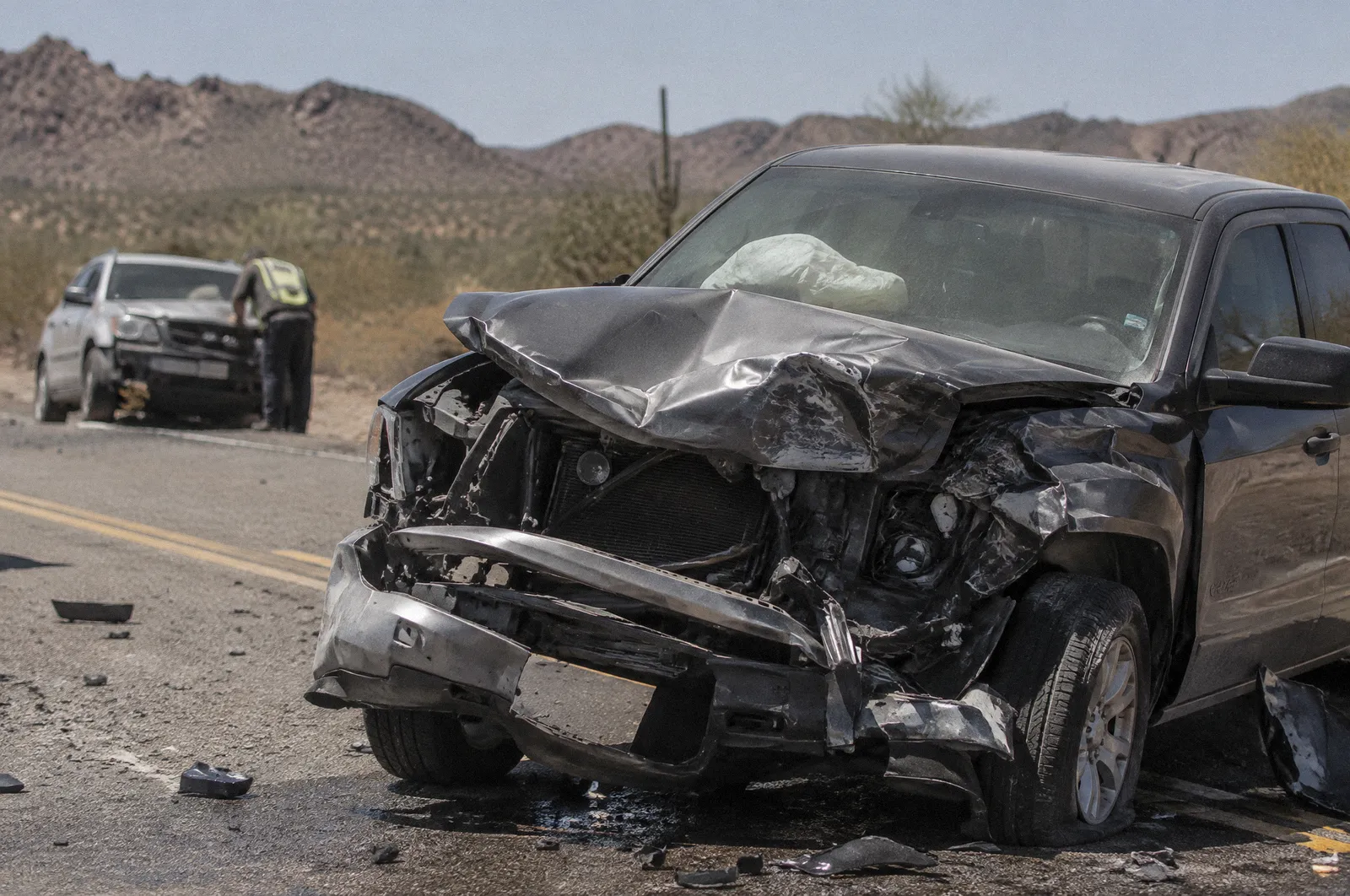
Arizona is a pure comparative fault state (A.R.S. 12-2505). Even if you were partly at fault, you can still recover, reduced by your percentage. Adjusters know this and often argue for a higher percentage than the evidence supports, so Arizona comparative negligence matters in almost every case.
Most car accident claims must be filed within two years (A.R.S. 12-542). A claim involving a City of Phoenix vehicle, a public bus, or an ADOT vehicle requires a notice of claim within 180 days (A.R.S. 12-821.01), and a lawsuit against a public entity generally must follow within one year after the claim accrues (A.R.S. 12-821). These rules have exceptions, so call us and we will explain how they apply to you.
Arizona
The Court and Hospitals Behind a Phoenix Claim
If a claim cannot be settled, a lawsuit from a Phoenix crash is usually filed in Maricopa County Superior Court in downtown Phoenix. Medical records from the hospitals below often become the center of the case, and our guide to Phoenix area trauma centers explains how.
Maricopa County Superior Court
Downtown Phoenix, East Court Building, 101 W. Jefferson St.
Valleywise Health Medical Center
A Level I trauma center in central Phoenix.
Banner University Medical Center Phoenix
A Level I trauma center and teaching hospital.
HonorHealth John C. Lincoln Medical Center
Treats many patients from north Phoenix.
St. Joseph's Hospital and Medical Center
A Level I trauma center, also home to the Barrow Neurological Institute.
Working With Valley Accident Law After a Phoenix Crash
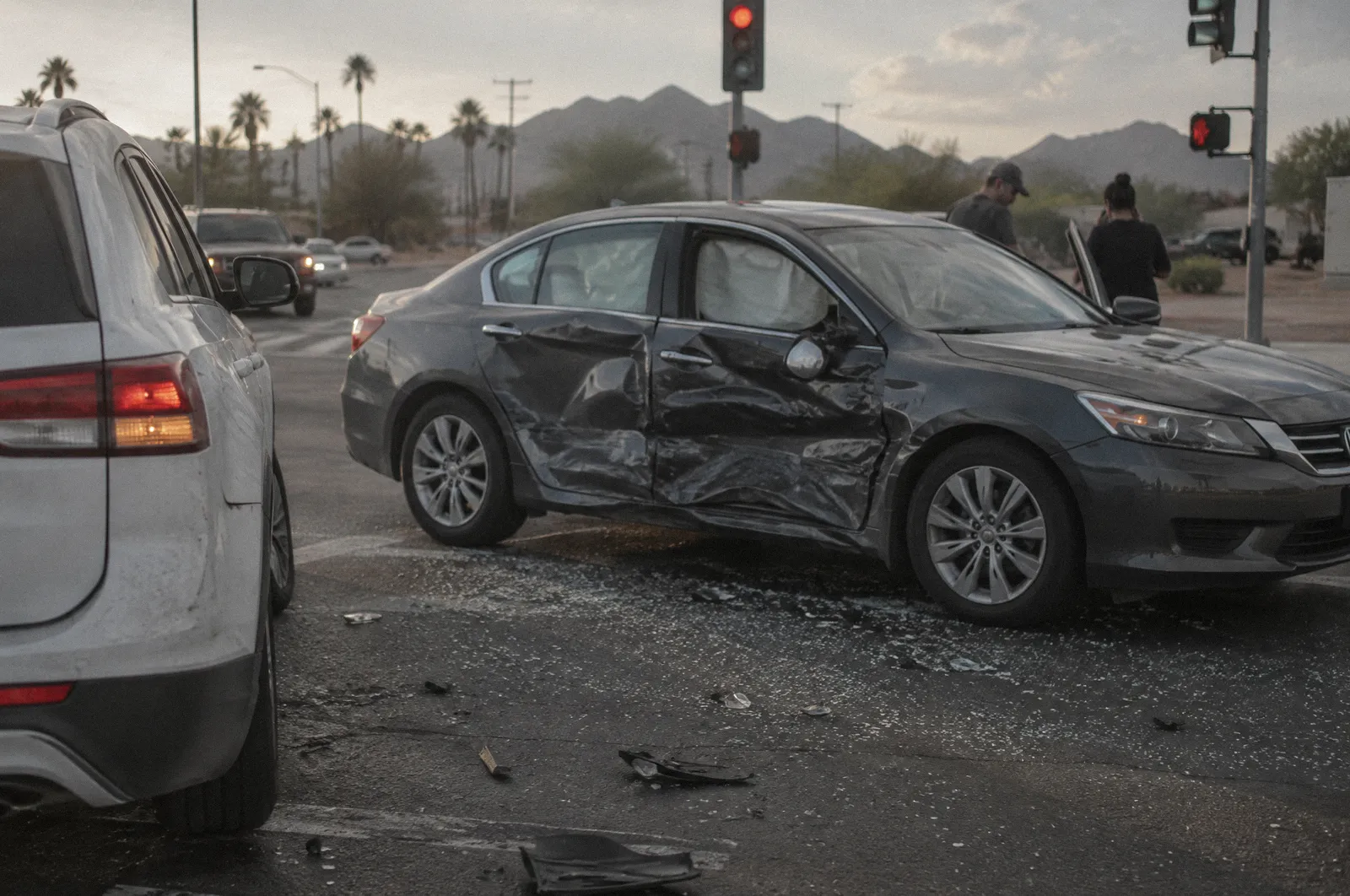
Searching for a car accident lawyer in Phoenix, AZ usually means you are overwhelmed. Many people ask a car wreck lawyer in Phoenix for help only after the first adjuster call, when the first offer has already appeared. Our job is to slow that down and put the evidence in front of the insurance company.
If you want to compare firms, a Phoenix auto accident attorney should be able to say who handles your case, how fees work, and what to expect. You pay no attorney fee unless we recover money for you. Our experienced and friendly attorney will explain your legal rights and what your case may be worth. Call (602) 584-8054 or request your free case review. Our larger Phoenix personal injury lawyer page shows the other kinds of cases we take.
Related pages
Types of car accident claims
Questions
Questions about Phoenix car accident cases
Do I need a car accident attorney in Phoenix?
Not every crash needs one, but if you were hurt, an attorney can explain your options before you agree to anything with an insurance company. The earlier you call, the better, but it's never too late to find out your legal rights.
How long do I have to file?
Two years for most claims, and 180 days for notice of a claim against a government entity. These rules have exceptions, so call us.
Who writes my crash report in Phoenix?
The Phoenix Police Department generally writes reports for crashes on city streets, and Arizona DPS generally handles freeway crashes.
Should I give a recorded statement to the other driver's insurer?
You are not required to agree to one. Early statements are often used to limit claims, so talk with us first.
What if I was partly at fault?
Arizona is a pure comparative fault state. You can still recover, reduced by your fault percentage. Insurance companies and attorneys often negotiate that percentage.
What if the other driver left or had no insurance?
Your own uninsured motorist coverage may apply. We review your policy and any other available coverage.
What if my injuries seem minor?
Many injuries show no or seemingly minor symptoms at first. A call to an auto accident lawyer in Phoenix lets you hear your options before you agree to anything.
How much does it cost to hire you?
You pay no attorney fee unless we recover money for you. We will explain how costs are handled during your free case review.
Free case review
Let Us Answer Your Questions About Your Phoenix Crash
Call (602) 584-8054 or request your free case review. Our experienced and friendly attorney will explain your legal rights. The earlier you call, the better, but it's never too late to find out your legal rights.
Call any time. Office visits Monday to Friday, 9 to 5.
Thank you, we’ve received your request.
A member of our team will reach out shortly. If your matter is urgent, call us now at (602) 584-8054.