
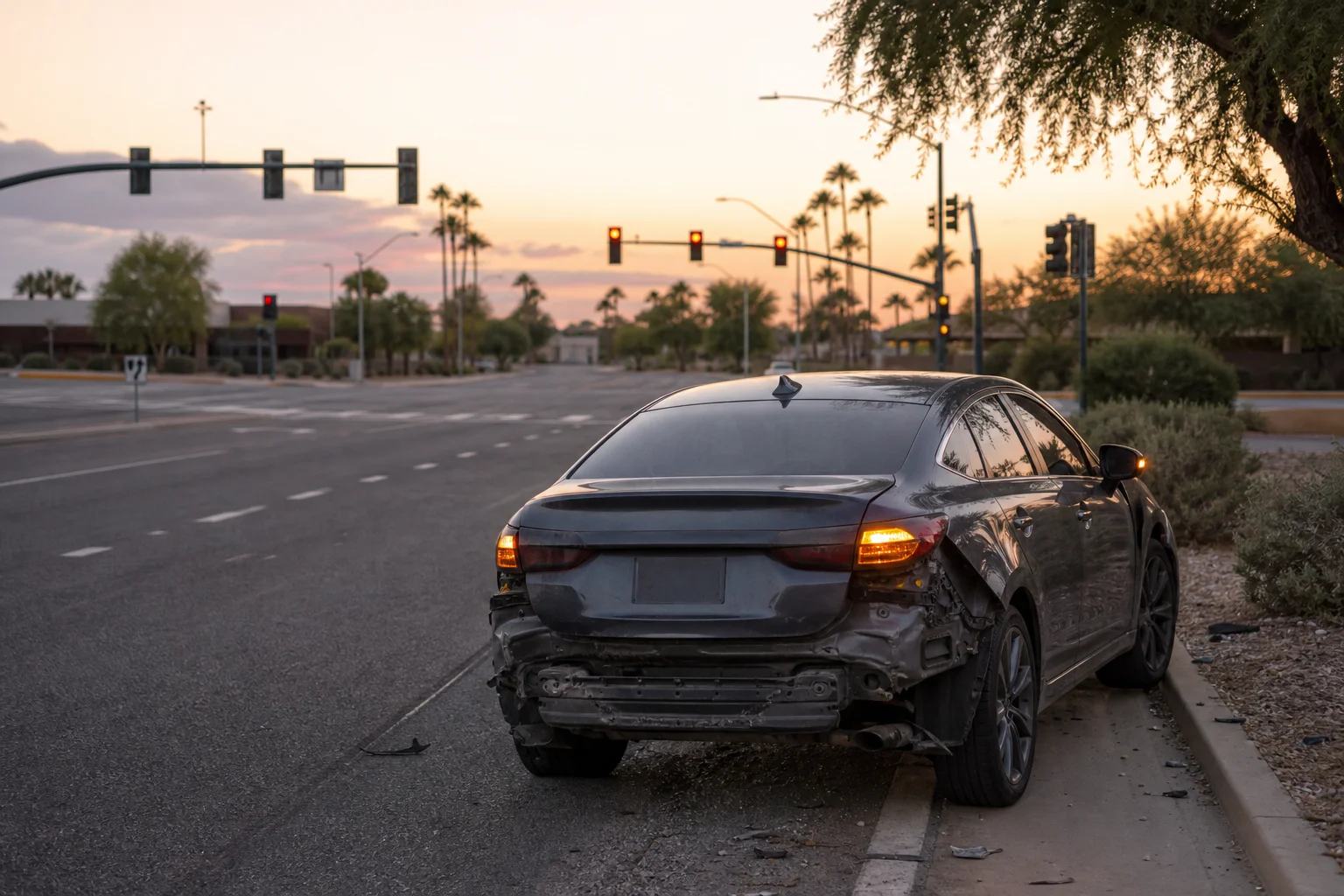
If another car forced you off the road and vanished, or you were struck with no driver in sight, Arizona law still lets you recover. Our Hit and Run Accidents attorneys explain how uninsured motorist coverage pays for a phantom vehicle or no contact hit and run in Glendale, once you report the crash and can back up your account of what happened.
By Charles Paglialunga, Esq., Founder, Valley Accident Law, 32 years Arizona personal injury
A phantom vehicle claim comes up when the other driver never stops, never gives a name, and sometimes never even touches your car. You swerve to avoid a vehicle drifting into your lane on 59th Avenue, you overcorrect, and you hit the median. The driver who caused it is gone before you catch a plate number. Other cases involve actual contact: a vehicle sideswipes you near Bell Road and Glendale Avenue and speeds off before you can react.
Arizona’s uninsured motorist statute, A.R.S. section 20-259.01, is built for exactly this gap. It requires every auto insurance policy sold in this state to include uninsured motorist coverage unless the policyholder rejects it in writing. That coverage exists because not every at-fault driver can be identified, and not every identified driver carries a policy that can cover what they caused. Glendale sees its share of both. A driver with no auto insurance who clips your bumper on Glendale Avenue and a driver you never see at all are treated the same way under your policy: unknown and unable to pay, so your own carrier steps in.
The distinction matters for how you build your claim, not whether you have one. Car Accidents involving an identified but fleeing driver require a police report naming a description or partial plate if you have one. Phantom vehicle claims where no vehicle ever appears in a report require something else entirely: proof that a real vehicle caused your loss, even though no one can name it.
Why Physical Contact Matters for Your Insurance Company
This is where most Glendale drivers get tripped up. Physical contact is not required for a phantom vehicle claim in Arizona. You can make a no contact hit and run claim against your own uninsured motorist coverage even if the other vehicle never touched yours. Insurance companies used to write physical contact requirements into their policies, and the Arizona Supreme Court has held those clauses void. Contact still matters for a practical reason: where there was contact, even a grazed side mirror, a scuff from debris the phantom vehicle kicked into your lane, or paint transfer on your bumper, the marks themselves show that another vehicle was involved.
Without physical contact, the law adds one condition. Under A.R.S. section 20-259.01(M), you must provide corroboration that the unidentified vehicle actually caused the crash, rather than a pothole, a tire blowout, or driver error with no other driver present. That is the coverage doing what it was designed to do: pay for losses a real but unidentifiable vehicle caused, not every solo accident. An independent eyewitness is the strongest corroboration, but it is not the only kind. Video counts, including dashcam recordings, storefront security footage, and doorbell cameras. So does physical evidence at the scene, such as skid marks, paint transfer, or a debris pattern that fits a sudden swerve, and so do 911 and police dispatch records that capture a description of the vehicle that ran you off the road.
Document everything before memory fades. Photograph your vehicle, including any point of contact, the roadway, and any visible marks left by the phantom vehicle. Get contact information from anyone who saw what happened, and ask nearby businesses and homeowners about cameras right away, because video is often recorded over within days. Call police immediately so the report reflects a fresh account rather than one reconstructed days later.
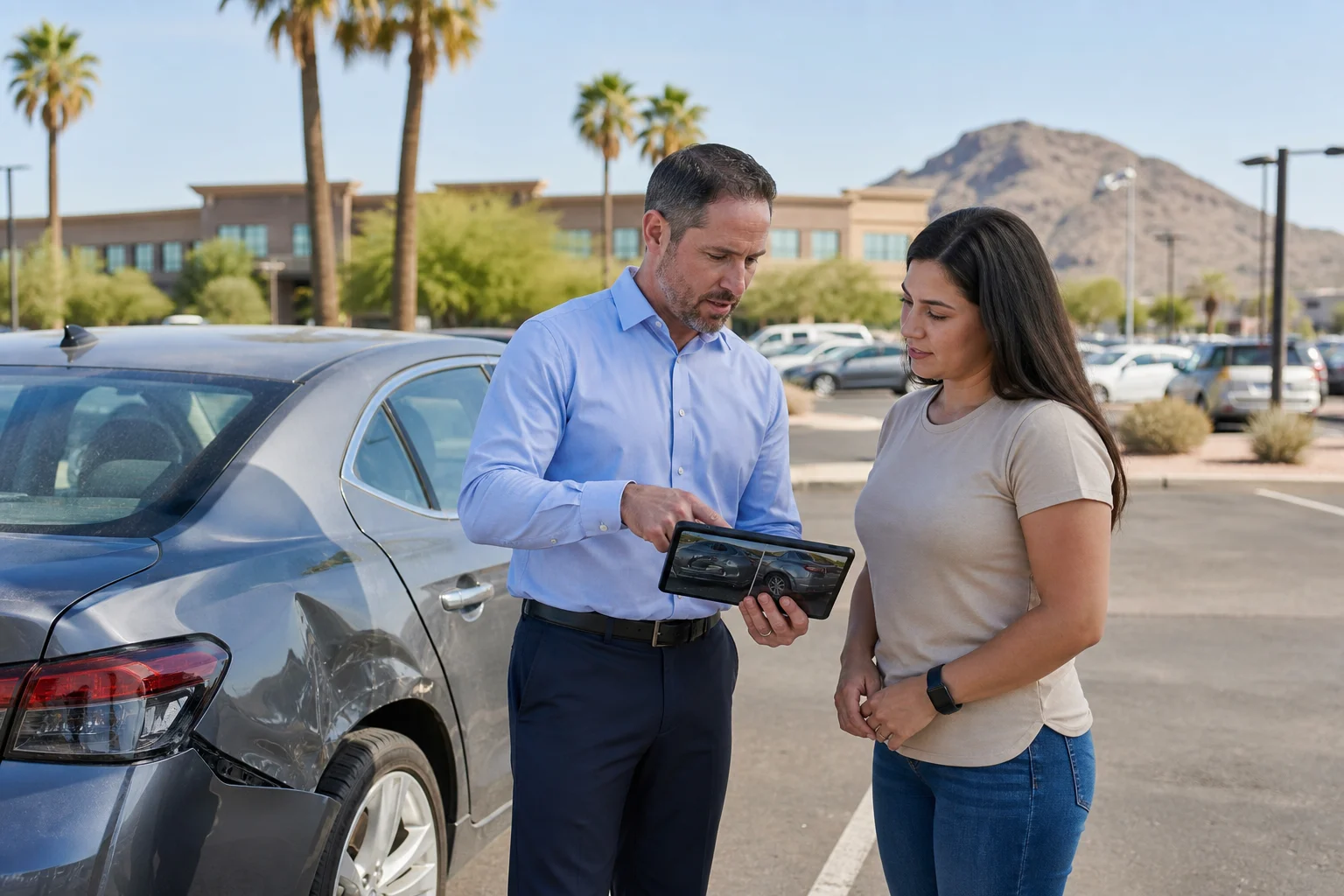
Once cause is established, and corroborated where there was no contact, your claim moves against your own policy rather than against the other driver, because there is no other driver to pursue. Your insurance company treats the phantom vehicle’s operator as an uninsured motorist and evaluates the claim the same way it would evaluate a claim against an identified driver who had no coverage at all.
That means your uninsured motorist coverage can pay for medical bills tied to the crash, lost income if your injuries kept you off work, and pain and suffering, subject to your policy’s limits. In Arizona, uninsured motorist coverage generally does not extend to property damage to your own vehicle unless you purchased that add-on separately or carry collision coverage, so check your declarations page before assuming repairs are covered under the UM line. If repairs to your vehicle are denied or undervalued, ask the adjuster for a written explanation of how they reached that number, then get an independent repair estimate to compare against it. Insurers sometimes offer a lowball payout hoping the gap goes unchallenged, and a documented second estimate is often enough to reopen the conversation.
The insurance company handling your claim is your own insurer, but that does not mean the process is adversarial-free. Insurers still investigate, still question the extent of injuries, and still look for reasons to limit a payout. Treat a phantom vehicle claim with the same seriousness as a claim against a named, insured driver, because in practice, it is evaluated the same way.
Uninsured Underinsured Motorist Coverage and What Arizona Law Requires
Arizona requires insurers to offer both uninsured and underinsured motorist coverage on every policy, and most drivers in Glendale carry some form of it, often without realizing how it applies until a hit and run happens. Underinsured motorist coverage works differently from uninsured motorist coverage: it applies when the at-fault driver is identified and carries auto insurance, but their liability limits are too low to cover your medical bills, lost wages, and other losses.
Some policies combine the two into a single uninsured underinsured motorist limit, while others list them as separate line items with separate dollar limits. Either way, this is the coverage doing the work when the person who caused your crash cannot pay in full or cannot be found at all. These limits can stack, apply, and interact with an at-fault driver’s own policy in ways that are easy to misjudge, and understanding uninsured and underinsured motorist coverage in more detail can help you spot gaps before they cost you at settlement.
Arizona is an at-fault state, not a no-fault state, which shapes how uninsured motorist claims get evaluated even when there is no identified driver to bill directly, and that distinction affects how liability gets assigned when a phantom vehicle is later identified or a second vehicle shares fault. Glendale drivers often misjudge this at-fault state distinction, assuming a claim only moves once someone else is named at fault.
Steps to Take After a No Contact Hit and Run in Glendale
- Call police from the scene, even if the other vehicle is long gone. A same-day report carries more weight with an insurance company than a report filed after the fact.
- Photograph your vehicle, the roadway, skid marks, and any debris before it is cleared or the scene changes.
- Identify witnesses and get their contact information before they leave. A witness who saw the phantom vehicle swerve is often the difference between a paid claim and a denied one.
- Notify your insurance company promptly. Most policies require notice of a claim within a set window, and delay can be used against you later.
- See a doctor even if injuries feel minor at first. Soft tissue injuries and concussions from a sudden swerve or impact often worsen over the following days.
- Keep every receipt, every bill, and every note about missed work tied to the crash.
Settlement timing on uninsured motorist claims varies depending on how quickly liability and damages are documented. Claims tend to move faster when the police report, medical records, and repair estimates are complete and consistent, and slower when there is a dispute over fault, extent of injury, or missing documentation.
Frequently Asked Questions
Do I need to prove physical contact for every phantom vehicle claim in Glendale?
No. Arizona law does not require physical contact between your vehicle and the phantom vehicle to support a no contact hit and run claim under your own uninsured motorist coverage. If there was no contact, you must provide corroboration that the unidentified vehicle caused the crash (A.R.S. 20-259.01(M)), such as a credible independent witness, dashcam or security footage, physical evidence at the scene, or 911 and police dispatch records.
What if the other driver had auto insurance but not enough to cover my injuries?
That is an underinsured motorist claim, not an uninsured motorist claim. Your underinsured motorist coverage can make up the difference between what the at-fault driver’s policy pays and your actual medical bills, lost wages, and other documented losses, up to your own policy’s limits.
Does uninsured motorist coverage pay for property damage to my car?
In Arizona, standard uninsured motorist coverage usually covers injuries, not vehicle repairs, unless you added property damage coverage or carry separate collision coverage. Review your declarations page or call your insurance company directly to confirm what your specific policy includes before assuming repairs are excluded.
How long do I have to report a hit and run to my insurance company in Glendale?
Most policies require prompt notice, often within days, not months. Waiting can give your insurance company grounds to question the claim. Report the crash to police and your carrier as soon as you are able, and follow up in writing so there is a clear record of when you notified them.
Can I still file a claim if I never saw the other vehicle at all?
Possibly, depending on the evidence available. Physical contact with the phantom vehicle or debris it caused, or corroboration such as video, physical evidence at the scene, or a witness account, combined with a same-day police report, gives you the strongest foundation. Every case turns on its specific facts, so a prompt case review helps identify what evidence you already have.
Get Straight Answers About Your Uninsured Motorist Claim
A phantom vehicle or no contact hit and run claim can turn on details most drivers never think to document in the moment. If you were hit in Glendale and the other driver never stopped, a free consultation with our team can show you what your policy actually covers. Contact / Free Case Review today to get started.