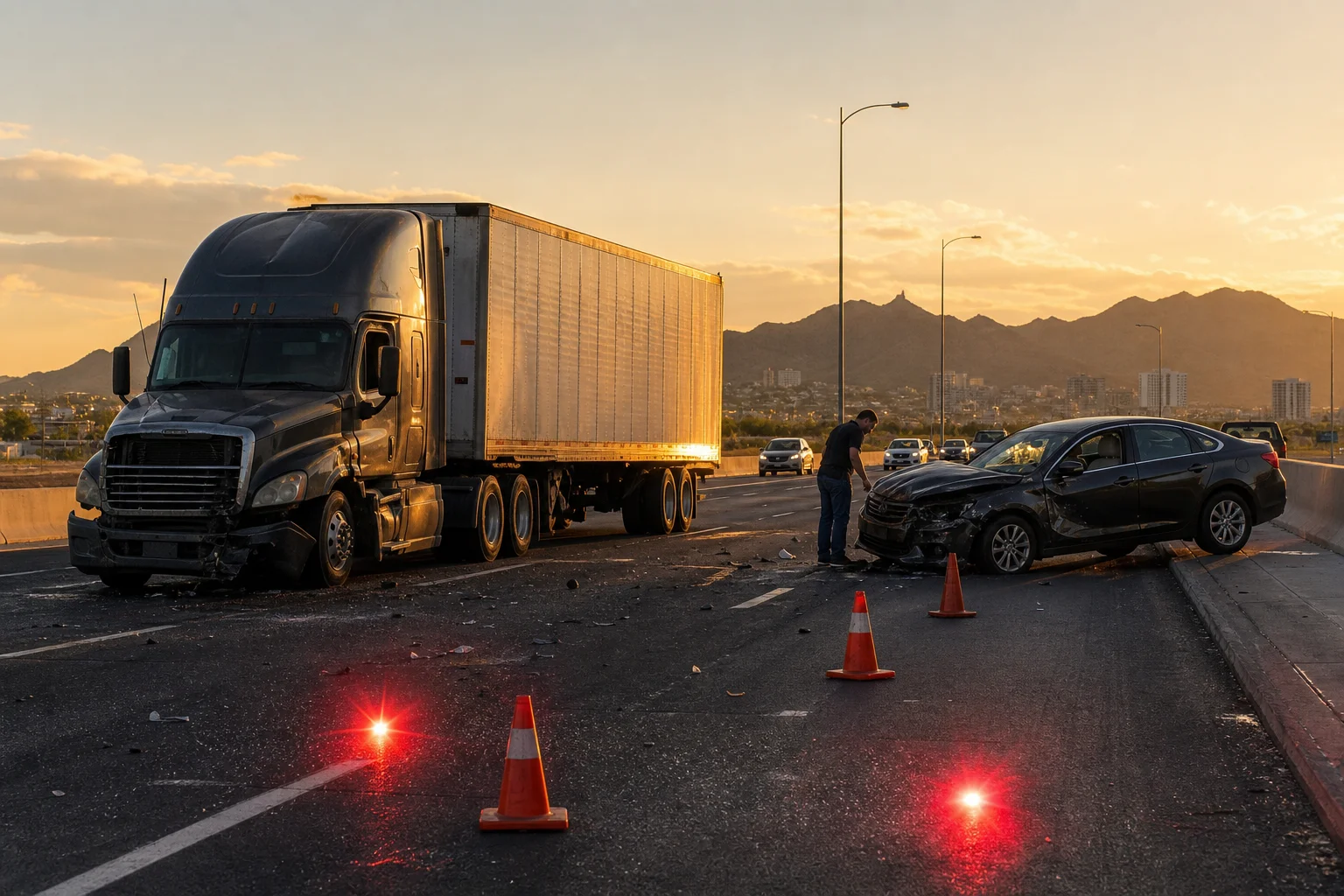

Commercial truck accidents on Arizona interstates rank among the most destructive highway crashes in the state. A loaded semi can weigh 80,000 pounds, and when that mass hits a passenger vehicle at speed, injuries are severe and liability is far more complicated than in a standard Truck Accidents case.
By Charles Paglialunga, Esq., Founder, Valley Accident Law, 32 years Arizona personal injury
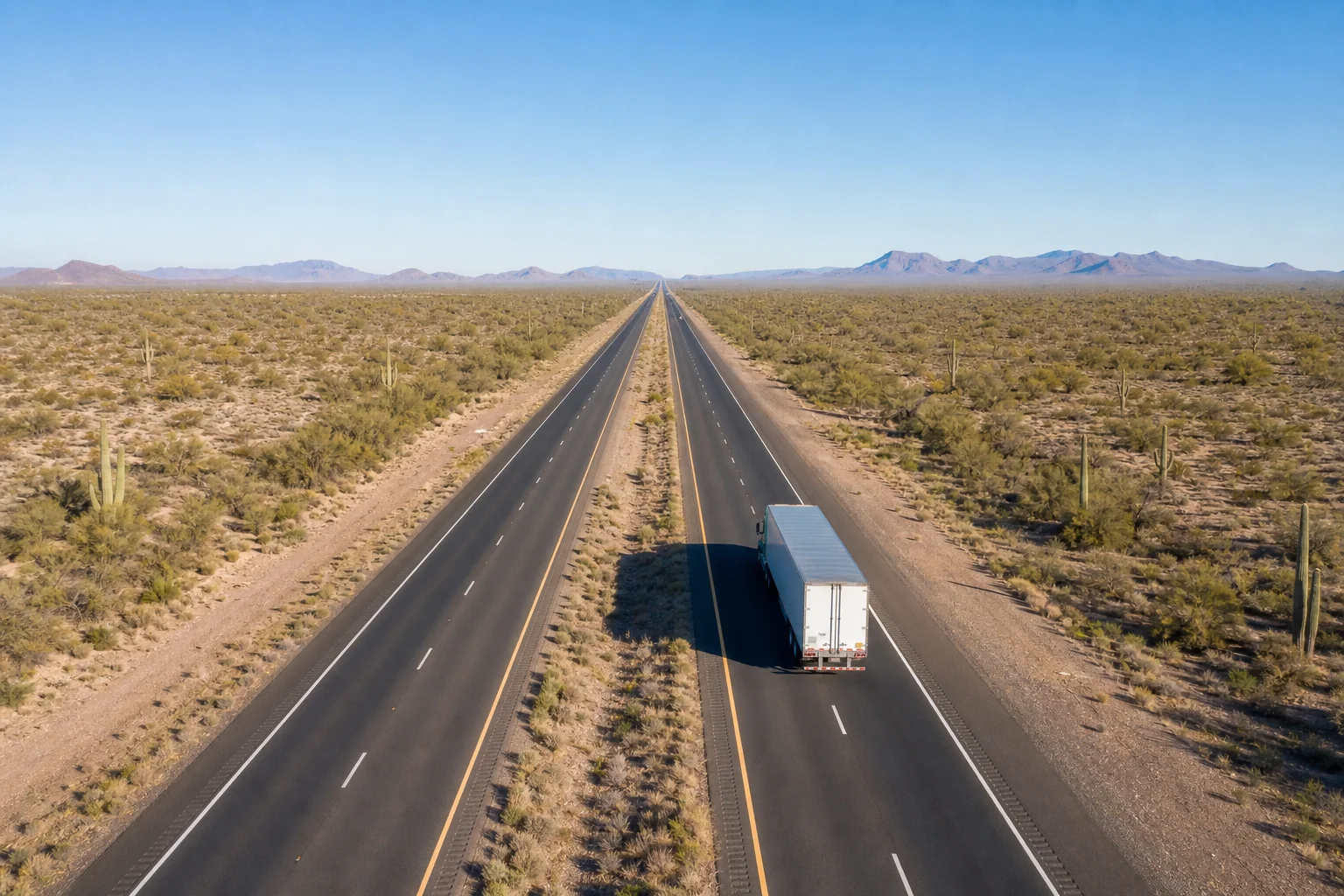
Arizona sits at a major freight crossroads. Interstate 10 connects Phoenix to Los Angeles and El Paso. Interstate 40 runs east to west across the northern half of the state, serving as a trucking corridor that connects to routes reaching Las Vegas and the Pacific Northwest. Interstate 17 links Phoenix to Flagstaff and beyond. Every day, thousands of commercial trucks move through this network carrying goods between West Coast ports, Midwest warehouses, and Southwest distribution centers.
That volume creates serious exposure. An average fully loaded semi weighs approximately 40 times more than a standard passenger vehicle. At interstate speeds, that weight differential means even a glancing impact from a commercial vehicle can total a car and send occupants to a trauma center. Arizona’s long open stretches also contribute to the problem. Long desert runs on I-10 between Tucson and the California border give commercial drivers few visual cues to stay alert, increasing the risk of fatigued driving behind the wheel of a large commercial vehicle.
Federal Oversight and the Arizona Department of Transportation
Commercial trucks do not operate under the same rules as private vehicles. They fall under a layered regulatory system covering both federal and state requirements.
At the federal level, the Federal Motor Carrier Safety Administration (FMCSA) sets hours-of-service limits that cap how many consecutive hours a truck driver can operate. The FMCSA also mandates electronic logging devices to enforce those limits and requires carriers to maintain documented inspection and maintenance records. Any carrier operating across state lines must comply regardless of where the truck is registered.
At the state level, the Arizona Department of Transportation (ADOT) enforces size and weight limits on Arizona highways, issues permits for oversized loads, and coordinates with law enforcement for roadside inspections. ADOT safety corridor data is public record and can become relevant evidence in a crash case.
When a trucking company or driver violates either set of regulations, that violation can establish negligence under Arizona law. Hours-of-service violations, skipped maintenance, improperly secured cargo, and overloaded trailers each appear regularly in commercial truck accident litigation in Arizona courts.
Common Causes of Commercial Truck Accidents on Arizona Interstates
Driver Fatigue
Despite electronic logging requirements, fatigue remains a leading contributor to large truck crashes. The FMCSA’s Large Truck Crash Causation Study found that driver fatigue was a factor in a notable share of fatal crashes involving large trucks nationally. Long desert stretches on I-10 with few exits or visual landmarks can amplify drowsiness for drivers pushing toward their hours limit.
Speeding and Braking Failures
Trucks require far more stopping distance than passenger vehicles at highway speeds. Research published by the FMCSA shows that a truck traveling at 65 mph needs roughly 525 feet to stop, compared to about 316 feet for a passenger car. When a driver misjudges a slowing traffic line or enters a curve too fast, a rear-end crash or rollover can follow.
Improper Loading and Cargo Shifts
Cargo that shifts during transit can throw a trailer off balance, leading to a rollover or jackknife. Flatbed loads that are not properly secured can fall onto following vehicles. Arizona requires carriers to comply with FMCSA cargo securement rules, and violations are cited at weigh stations along I-10 and I-40.
Mechanical Defects
Brake system failures are a documented cause of commercial vehicle crashes. Trucking companies must maintain inspection logs, and failure to keep brakes, tires, and coupling equipment in safe condition can expose the carrier to liability.
Distracted Driving
Federal rules prohibit commercial drivers from texting or using handheld devices while driving. Violations still occur, and investigating distracted driving often requires subpoenaing phone records and pulling data from the truck’s electronic logging device.
Injuries That Follow a Commercial Truck Crash
The injury profile in commercial truck accidents on Arizona interstates differs sharply from car-to-car collisions. Because of the mass and height differential, passenger vehicle occupants are more likely to suffer:
- Traumatic brain injury from violent deceleration forces in a frontal impact
- Spinal cord damage, which can result in partial or complete paralysis
- Crush injuries when a car slides under a trailer
- Severe fractures of the pelvis, femur, and spine
- Internal organ damage
- Fatal injuries, particularly for front-seat occupants
Long recovery timelines and high medical costs make thorough documentation critical. Medical records, imaging studies, specialist opinions, and future care projections all factor into the damages picture. Arizona courts allow recovery for past and future medical expenses, lost earning capacity, pain and suffering, and in cases involving gross negligence, punitive damages.
Commercial trucking cases often require accident reconstruction experts, FMCSA compliance specialists, and medical economists to build a complete claim. Working with an Arizona truck accident lawyer who has handled FMCSA cases gives you access to investigators who know exactly where to look for this evidence.
Steps to Take After a Truck Accident on an Arizona Highway
The period after a truck crash is chaotic. These steps can protect your claim:
Call 911 immediately. Arizona law requires drivers involved in crashes that cause injury or property damage to report the accident. An official police report creates a baseline record of the scene.
Seek medical attention the same day. Internal injuries and spinal trauma may not produce obvious symptoms for hours or even days. A same-day evaluation ties your injuries to the crash date.
Photograph the scene if you are able. Skid marks, debris patterns, the truck’s position, and spilled cargo can disappear quickly once cleanup crews arrive.
Preserve evidence from the truck. Commercial vehicles carry electronic logging device data, GPS records, dash camera footage, and onboard diagnostic information. This data can be overwritten in as little as 30 days. An attorney can issue a spoliation letter to the carrier within days of the crash to prevent destruction of that evidence.
Do not give recorded statements to the carrier’s insurer. Trucking companies carry substantial commercial insurance policies and employ claims adjusters who begin working the case immediately. A statement made before you understand your full injuries can be used to limit your recovery.
For a broader overview of how vehicle accident claims work in Arizona, the Car Accidents page outlines the general process for passenger vehicle cases.
Frequently Asked Questions
Who can be held liable in a commercial truck accident? Liability in a truck crash often extends beyond the driver. The trucking company, cargo loading company, truck manufacturer, and any leasing company can each share responsibility depending on what caused the crash. Arizona follows a comparative fault system, so multiple defendants can share liability proportionally based on their degree of fault in causing the accident.
How long do I have to file a claim in Arizona after a truck accident? Arizona Revised Statutes section 12-542 sets a two-year statute of limitations for personal injury claims. The clock typically starts on the date of the accident. If a public entity such as a city, a county or the state may be responsible, a written notice of claim is due within 180 days (A.R.S. 12-821.01). Missing that deadline generally bars any recovery, so acting promptly after a truck crash is important.
What if the truck driver was classified as an independent contractor? Trucking companies sometimes argue that contractor classification shields them from liability. Arizona courts examine how much control the carrier exercised over the driver’s work. If the carrier controlled the route, hours, and equipment, courts may still hold the carrier liable under agency or statutory employment theories.
What evidence is most important in a truck accident case? The truck’s electronic logging device data, the carrier’s maintenance and inspection records, the driver’s qualification file, and any available dash camera footage are typically most valuable. Electronic logging device data can be overwritten quickly, which is why early legal action matters after any serious commercial truck crash.
Does Valley Accident Law handle fatal truck accident cases? Yes. Wrongful death claims from fatal truck crashes follow a separate legal process and involve distinct categories of damages, including loss of consortium and funeral costs. Family members may bring these claims under Arizona law within two years of the date of death.
Talk to Valley Accident Law After a Commercial Truck Accident on an Arizona Interstate
If you or someone in your family was injured in a commercial truck accident on an Arizona interstate, the choices made in the first few days can shape your entire case. Valley Accident Law represents injured Arizonans on a contingency basis, meaning you owe nothing unless we recover compensation on your behalf. Start with a Contact / Free Case Review to speak directly with Charles Paglialunga.