

Hit and run accidents in the Phoenix area strike without warning and leave injured victims facing medical bills, lost income, and unanswered questions about who will be held accountable. If you were hurt by a driver who fled the scene, review the Car Accidents resource for an overview, then read on for the specific steps Arizona law gives you to pursue recovery.
By Charles Paglialunga, Esq., Founder, Valley Accident Law, 29 years Arizona personal injury
How Often Do These Crashes Happen in Arizona
The AAA Foundation for Traffic Safety reported that hit-and-run crashes account for roughly 11 percent of all traffic fatalities in the United States and claimed nearly 2,000 lives in a single year (AAA Foundation for Traffic Safety, 2018). Arizona consistently appears in national data as a state with elevated hit-and-run rates, and the Phoenix metro amplifies the problem. Dense freeway corridors, high volumes of nighttime traffic on arterials like Scottsdale Road and Van Buren Street, and large pedestrian populations near light rail stations all contribute to the frequency of these events.
A hit-and-run crash is not limited to highway collisions at speed. Parking lot impacts, low-speed neighborhood sideswipes, bicycle lane incidents, and pedestrian strikes all qualify as hit and run accidents when the driver flees without exchanging information or rendering aid. These are car accident cases, but they carry an added layer of legal complexity because the at-fault driver is missing from the scene.
What Arizona Statutes Require When a Collision Happens
Arizona Revised Statutes Section 28-661 requires every driver involved in a collision resulting in injury, death, or property damage to stop immediately at the scene. The driver must provide their full name, home address, vehicle registration number, and driver license to the injured party and to any law enforcement officer who responds.
Section 28-663 adds a duty to render reasonable assistance. If a person appears to need medical care and an ambulance has not yet been called, the driver must take steps to obtain it.
Leaving an injury accident is a class 3 felony in Arizona. When the crash produces serious physical injury or a fatality, that charge escalates to a class 2 felony. Even an unreported minor property-damage collision can produce a misdemeanor charge. This criminal context matters to your Personal Injury claim because it establishes that the driver violated both civil and criminal duties, which courts and insurers weigh when evaluating the evidence.
How Hit and Run Accidents in the Phoenix Area Are Investigated
Arizona law enforcement uses layered investigative tools to identify drivers who flee:
- Automated license plate readers positioned on major corridors throughout the metro
- Traffic camera footage from the Arizona Department of Transportation network
- Surveillance video from gas stations, retail centers, ATMs, and private residences
- Witness accounts collected at the scene and through public tip lines
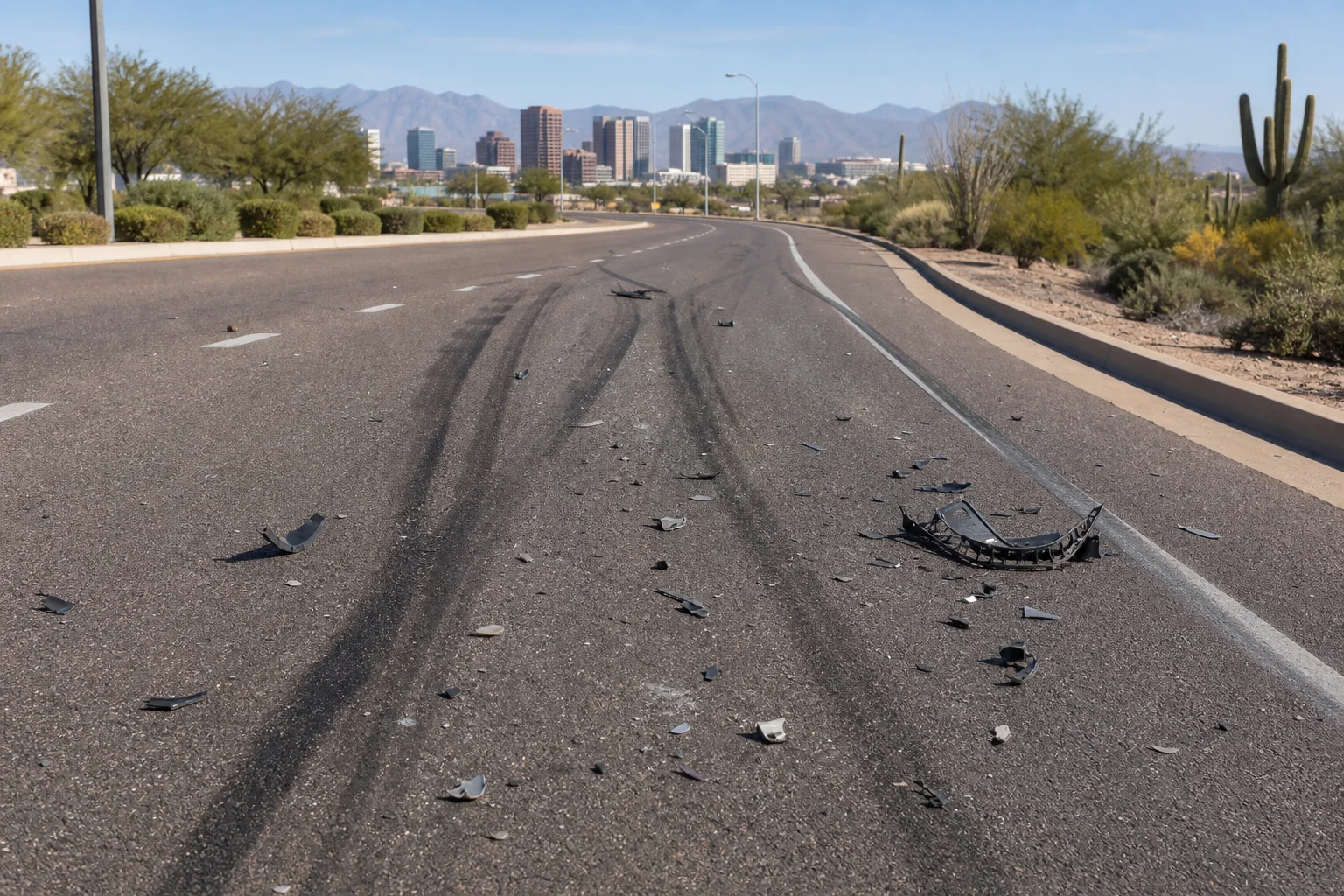
- Physical evidence including paint transfer, broken vehicle parts, glass distribution, and tire marks
When police said a vehicle matching the description was recorded near the crash site, investigators can often identify a short list of registered owners through the Arizona Motor Vehicle Division within hours of the incident. Arrests in Phoenix-area hit-and-run cases have followed tips submitted days or even weeks after the original collision.
Public appeals are a standard investigative tool in these cases. Police said anyone information about the fleeing vehicle, including color, make, model, or partial plate number, should be reported to the agency handling the case. The Phoenix Police Department maintains a tip line for exactly these appeals. Your attorney can also subpoena business surveillance footage independently, often before it is overwritten, since many systems purge recordings on 30 or 60 day cycles.
What to Do Immediately After a Hit-and-Run Crash
Call 911 Right Away
A police report is essential for your insurance claim and for any future personal injury lawsuit. Call 911 even if your injuries feel minor and even if you believe bystanders already made the call. Confirm that a report is being filed before you leave the scene. Without a report, insurers have grounds to slow or dispute your claim.
Document the Scene
Photograph your vehicle damage, surrounding debris, skid marks, and the intersection itself. Record the time, direction of travel, and any traffic signals or signage nearby. If you noted any detail about the other car, including a partial plate, body color, decals, or visible damage on the fleeing vehicle, write it down immediately. Memory fades quickly after traumatic events.
Get Witness Names and Contact Information
Bystanders, pedestrians, and other drivers often have a better vantage point than the victim does at the moment of impact. Ask anyone nearby for their contact information. A lawyer working your case can follow up with these witnesses and take sworn statements while the details are still fresh.
Seek Medical Attention Today
Traumatic brain injuries, spinal compression, and soft tissue damage do not always produce obvious symptoms at the scene. Seeing a doctor today, the same day as the crash, creates a medical record that ties your injuries directly to the incident. This documentation is critical for your insurance claim and for any future litigation.
Recovering Compensation After Hit and Run Accidents in the Phoenix Area
Many injured victims assume they have no legal options if the at-fault driver is never identified. That is not accurate under Arizona law.
Uninsured Motorist Coverage
When the responsible driver cannot be identified, Arizona’s uninsured motorist coverage applies. Insurers operating in Arizona are required to offer this protection, and if you purchased it, your own policy may compensate you for medical expenses, lost wages, pain and suffering, and other documented losses up to your policy limits. Uninsured motorist coverage was specifically designed for situations like hit and run accidents where the at-fault driver leaves no traceable insurance information.
Bad Faith Insurance Practices
Arizona courts have established that an insurer cannot deny a valid hit-and-run claim simply because the other driver was never found. If your insurance company is stalling your claim, disputing coverage without a legitimate basis, or offering a settlement that does not reflect your actual damages, a personal injury lawyer can pursue a bad faith claim against the company, which can result in damages beyond the policy limit.
Third-Party Liability
In some hit-and-run cases, a third party shares legal responsibility for the accident. A property owner who failed to maintain adequate lighting in a parking lot, a bar or restaurant that served an obviously intoxicated patron who then drove, or a company whose employee caused the crash during work hours may all carry partial liability. Identifying these parties requires careful legal analysis of the facts and physical evidence from the scene.
Frequently Asked Questions
Can I still recover compensation if the hit-and-run driver was never found?
Yes. Arizona’s uninsured motorist coverage applies directly to hit-and-run accidents where the responsible driver is never identified. Your own auto insurance policy may cover medical bills, lost wages, pain and suffering, and property damage up to your policy limit. An attorney who handles these cases can review your policy language and file the claim correctly on your behalf.
How long do I have to take legal action after a hit-and-run accident in Arizona?
Arizona’s statute of limitations for personal injury claims is generally two years from the date of the accident. Missing that deadline means losing your right to sue, with limited exceptions for minors and cases where injuries were not immediately apparent. Do not wait. Contact a lawyer as soon as you are able to begin preserving evidence and protecting your legal rights.
What if I only have a partial description of the vehicle?
A partial description is still meaningful. Law enforcement can cross-reference partial plate numbers against Arizona Motor Vehicle Division records filtered by color and make. Surveillance footage retrieved promptly can confirm a vehicle match even without a complete plate. Write down every detail you remember and share it with police and your attorney right away.
Does Arizona require me to report a hit-and-run accident?
Yes. Arizona law requires reporting any collision that results in injury, death, or property damage above a set threshold. Calling 911 at the scene satisfies the reporting requirement for injury accidents. Failing to report can complicate your insurance claim and create gaps in your legal case that are difficult to close later.
What happens if the at-fault driver is identified after the fact?
If the driver is identified later, your claim transitions from a uninsured motorist claim to a standard personal injury claim against that driver and potentially their insurance company. All evidence gathered early, including the police report, photographs, witness statements, and medical records, will be central to proving liability and the full extent of your damages.
Talk Directly to a Valley Accident Law Attorney About Your Case
If you were injured in a hit-and-run accident in the Phoenix area and you are not sure where to turn, start with a no-cost, no-obligation conversation about your rights and options. Contact / Free Case Review with Valley Accident Law today and get clear, direct answers about what your case is actually worth.