

Traumatic brain injury car accident cases are among the most serious Personal Injury claims in Arizona. If you or someone you love suffered a head injury in a crash, the decisions you make in the weeks following can significantly affect what you recover. These cases are legally and medically complex, and the stakes are high.
By Charles Paglialunga, Esq., Founder, Valley Accident Law, 29 years Arizona personal injury
How Car Accidents Cause Traumatic Brain Injuries
Motor vehicle collisions produce sudden, violent forces that the human brain is not built to absorb. When a driver or passenger’s head strikes a steering wheel, dashboard, or window, or when the crash forces the brain to shift rapidly inside the skull without any direct contact, a traumatic brain injury can result. The second type, a closed head injury, is particularly common in rear-end crashes and side-impact collisions.
The brain floats in cerebrospinal fluid inside the skull. A sudden stop or abrupt acceleration causes the brain to move and strike the skull’s inner walls. That impact tears nerve fibers, bruises brain tissue, and can trigger bleeding or dangerous swelling. According to the Centers for Disease Control and Prevention (CDC, National Center for Injury Prevention and Control, 2022), motor vehicle crashes are one of the leading causes of traumatic brain injuries in the United States and a significant contributor to TBI-related hospitalizations.
Even crashes that seem minor can produce significant brain damage. Arizona’s major corridors, including Interstate 10 through Phoenix and State Route 101 through Scottsdale, see thousands of collisions each year, many involving the rapid deceleration forces that lead to traumatic brain injuries.
Recognizing Symptoms After a Head Injury in a Crash
Symptoms of a traumatic brain injury do not always appear at the scene. Some people feel fine immediately after the collision and notice problems only days or weeks later. That delay can be dangerous both medically and legally, because it creates gaps in the documentation that insurance adjusters use to question whether the crash caused the injury.
Symptoms to watch for include:
- Persistent headaches or pressure inside the head
- Memory loss, confusion, or disorientation about the events of the crash
- Sensitivity to light or sound
- Trouble concentrating or making decisions
- Mood changes, irritability, or unexplained depression or anxiety
- Nausea, vomiting, or dizziness
- Sleep disruption, sleeping far more or far less than normal
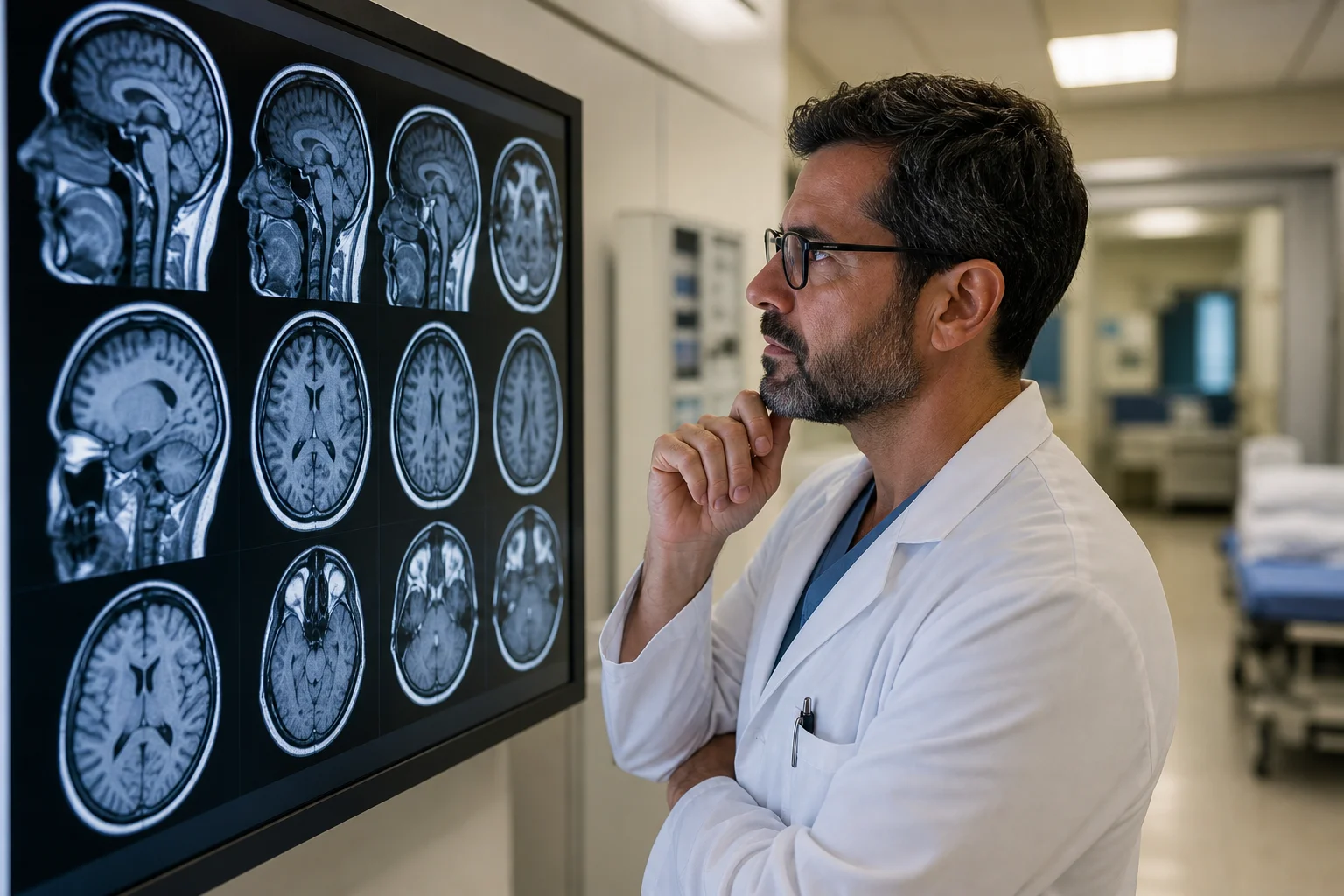
Severe traumatic brain injuries can produce loss of consciousness, seizures, slurred speech, or one-sided physical weakness. Diffuse axonal injury, a pattern of widespread brain damage caused by rapid rotational force, often does not appear on a standard CT scan and requires an MRI for proper detection.
If you experience any of these symptoms after a car accident, see a physician right away. That visit creates a medical record connecting your symptoms to the crash, which is foundational evidence in any brain injury claim.
What It Takes to Prove Liability in Traumatic Brain Injury Car Accident Cases
Arizona follows a pure comparative fault rule under A.R.S. Section 12-2505. Your compensation is reduced in proportion to your own share of fault, but you are not barred from recovery even if you were partly responsible for the crash. In traumatic brain injury car accident cases, proving the other driver’s negligence requires establishing four elements:
- Duty: The at-fault driver owed a legal duty of care to others on the road.
- Breach: The driver violated that duty through speeding, distracted driving, running a red light, or other negligent conduct.
- Causation: The breach directly caused the crash and the resulting brain injuries.
- Damages: You suffered real, measurable losses because of those brain injuries.
Evidence typically includes police reports, scene photographs, witness statements, traffic camera footage, and complete medical records documenting the head injury and its progression. Neurologists, neuropsychologists, and accident reconstruction specialists frequently serve as expert witnesses in these cases, connecting the crash mechanics to the documented brain damage.
How Insurance Companies Respond to Brain Injury Claims
An insurance company’s primary objective is to close claims at the lowest possible cost. Brain injury claims are expensive, and adjusters know it. Common tactics include asking you to give a recorded statement early in the process, before you fully understand your symptoms or prognosis, and offering a quick settlement before the long-term effects of the traumatic brain injury become clear.
You should not speak to the at-fault driver’s insurance company without legal counsel. Any statement you make can be used to minimize your claim. You should also think carefully before accepting any early settlement in a brain injury case. Cognitive difficulties, personality changes, reduced work capacity, and the need for long-term medical care may not be fully apparent in the first weeks after the crash. Once you accept a settlement, you cannot return for additional compensation, even if your condition worsens.
Valley Accident Law manages all contact with the insurance company on behalf of injured clients. For more on how Arizona law treats serious crash injuries, see our overview of Car Accidents and the recovery process.
Damages Available in Traumatic Brain Injury Car Accident Cases
Compensation in these cases covers both economic and non-economic losses. Economic damages represent concrete financial costs:
- Emergency care, hospitalization, and imaging
- Specialist visits and neuropsychological testing
- Physical, occupational, and cognitive rehabilitation
- Lost wages during recovery
- Reduced earning capacity if the injury limits your ability to work long-term
- Future medical expenses, including in-home care if needed
Non-economic damages address the personal toll:
- Physical pain and suffering
- Emotional distress, anxiety, and post-traumatic stress
- Loss of enjoyment in activities you could do before the crash
- Effect on your relationships and family life
In cases involving serious misconduct, such as a drunk driver or someone who fled the scene, punitive damages may also be available under Arizona law. Every traumatic brain injury car accident case is fact-specific, and recoverable damages depend on the strength of the evidence, the severity of brain damage, and how thoroughly the long-term effects are documented.
Frequently Asked Questions
How long do I have to file a brain injury car accident claim in Arizona?
Arizona’s personal injury statute of limitations is two years from the date of the crash under A.R.S. Section 12-542. Missing this deadline eliminates your right to compensation in almost every situation. If the at-fault driver was a government employee or a government vehicle was involved, notice requirements may be as short as 180 days. Do not wait to consult an attorney after any serious crash.
Can I recover compensation if I did not go to the hospital right after the crash?
Yes, but a gap in treatment creates a challenge. Insurance adjusters argue that a serious brain injury would have prompted immediate care. A physician can document that TBI symptoms often emerge gradually, which is well-supported in medical literature, but your attorney must address the gap directly. Delayed treatment does not disqualify your claim, but it requires careful handling of both the medical and legal record.
What does it mean if the emergency room called my brain injury mild?
In clinical terms, mild describes the level of initial presentation: loss of consciousness under 30 minutes and a Glasgow Coma Scale score of 13 to 15 on arrival. It does not predict long-term outcome. Mild traumatic brain injuries regularly produce lasting problems with memory, concentration, mood, and work performance. A personal injury claim can account for those long-term effects regardless of the initial severity classification.
How does an attorney prove brain damage when imaging looks normal?
Standard CT scans miss many forms of brain damage. Neuropsychological testing documents cognitive deficits in memory, processing speed, attention, and executive function that do not appear on imaging. Advanced techniques like diffusion tensor imaging can reveal structural damage in white matter tracts invisible on routine scans. Neuropsychologists and neurologists serve as expert witnesses to explain how significant brain damage can coexist with a normal CT result.
Does Valley Accident Law offer a free consultation for brain injury cases?
Yes. Valley Accident Law provides a free consultation to injured people and their families at no cost and no obligation. Cases are handled on a contingency basis, meaning there is no attorney fee unless compensation is recovered. This applies to traumatic brain injuries and all other personal injury matters Valley Accident Law handles across the Phoenix metro.
Talk to Valley Accident Law About Your Brain Injury Case
Valley Accident Law has handled traumatic brain injury car accident cases for clients across the Phoenix metro, including Scottsdale, Tempe, Mesa, and Chandler. If you or a family member suffered a brain injury in an Arizona crash, start with a Contact / Free Case Review and get clear answers from an attorney with 29 years of experience fighting for injured people in this state.