
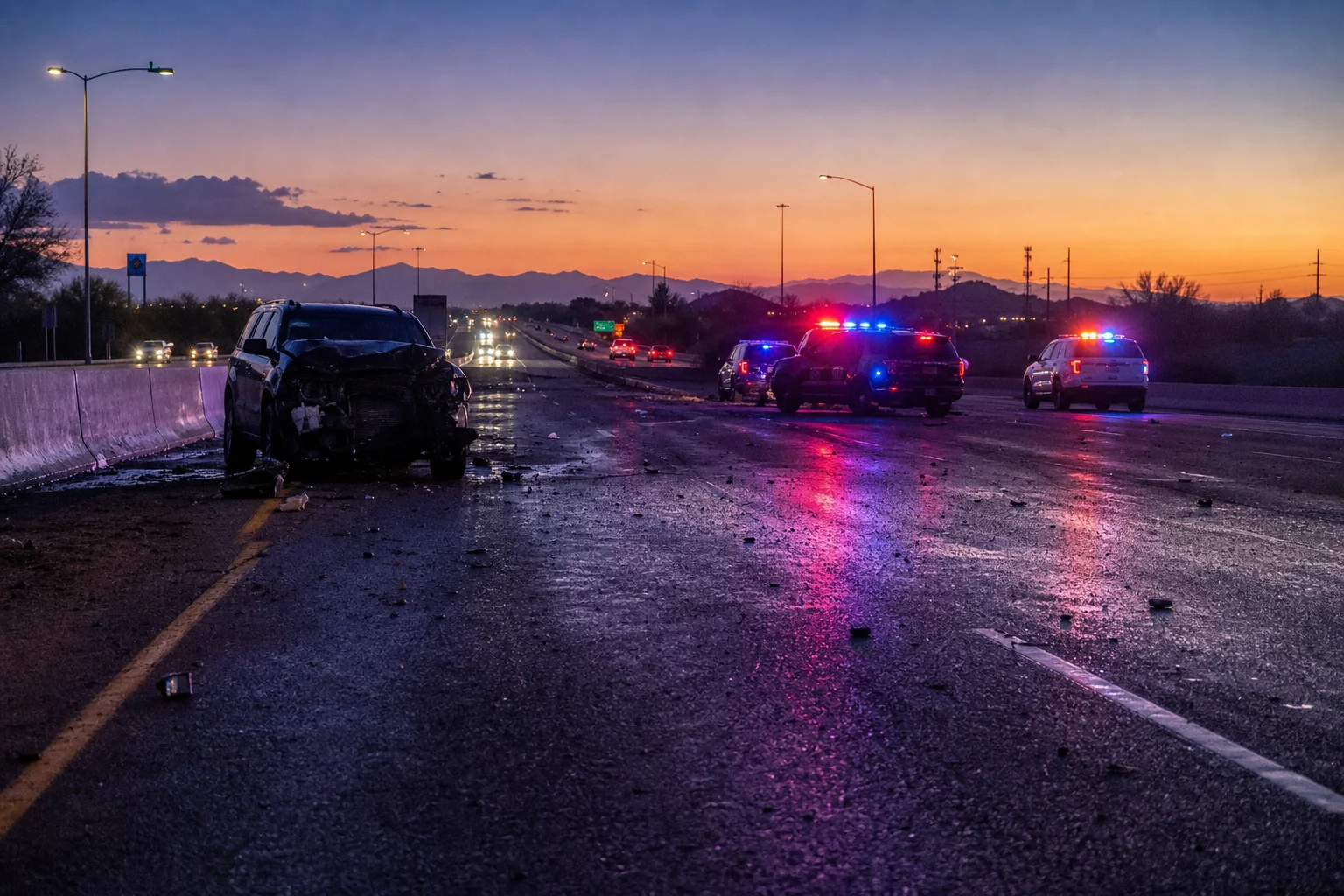
Drunk driving crash victims in Arizona have legal rights that extend well beyond what happens in criminal court. A civil lawsuit lets you recover medical expenses, lost wages, and pain and suffering, and Arizona courts can award punitive damages when a drunk driver acted with conscious disregard for others. Car Accidents cases involving alcohol impairment often produce the strongest evidence of fault available.
By Charles Paglialunga, Esq., Founder, Valley Accident Law, 29 years Arizona personal injury
How Arizona Civil Law Handles Drunk Driving Cases
A criminal DUI prosecution and a civil injury claim run on separate tracks. The state controls the criminal case. You control the civil case. You decide whether to settle or go to trial, and the outcome of the criminal proceeding does not determine your right to compensation.
Arizona uses a fault-based system for car accident liability. The driver who caused the crash is financially responsible for the harm that followed. When that driver was impaired by alcohol, evidence of fault tends to be substantial: police reports noting blood alcohol content, field sobriety test results, and witness observations all work in your favor.
Under A.R.S. § 28-1381, driving under the influence with a blood alcohol concentration of 0.08 percent or higher is per se unlawful. A DUI conviction is powerful evidence of negligence in a civil case, but it is not required. You can pursue a civil claim based on impairment alone, even if the criminal case was reduced or dismissed.
Drivers impaired by alcohol while driving Arizona roads face liability under both statute and common law. The drunk driver who injured you carries that liability regardless of how the criminal case resolves.
What Drunk Driving Crash Victims in Arizona Can Recover
Compensatory damages in a DUI injury case replace what you lost: emergency room and hospital bills, follow-up care, physical therapy, lost income during recovery, future lost earning capacity if the injury affects your ability to work, and pain and suffering.
Punitive damages go further. Arizona courts award them to punish conduct that reflects an evil mind, meaning the defendant was aware their behavior created a substantial risk of serious harm to others and proceeded anyway. The Arizona Supreme Court established this standard in Linthicum v. Nationwide Life Insurance Co. (1986).
Drunk driving regularly qualifies as the kind of conduct that supports punitive damages. A driver who gets behind the wheel with a blood alcohol level significantly above the legal limit, or who has prior DUI convictions on record, may face a punitive award in addition to compensatory damages. These awards are not guaranteed and no lawyer can promise them, but they are a real possibility when the facts involve clear recklessness.
If you are unsure whether punitive damages apply to your situation, a Personal Injury attorney can assess the specific facts and give you an honest evaluation of what the evidence supports.
Evidence That Builds a Strong Civil Case
Strong civil cases against a drunk driver depend on documentation gathered as early as possible after the accident.
Police and accident reports. Officers at the scene document field sobriety results, BAC readings, and direct observations of impairment. Request your report from the responding agency or through the Arizona Department of Public Safety.
Medical records. Every treatment record connects your injury to the crash. See a doctor immediately after the accident, even if your initial symptoms seem minor. Gaps in treatment give the defense an opening to argue your injuries were not serious.
Witness statements. Bystanders, other drivers, and first responders can all provide accounts of the drunk driver’s behavior before or at the moment of impact.
Surveillance and dashcam footage. Intersections near Apache Junction and throughout the Phoenix metro are increasingly covered by traffic cameras. Video can be overwritten within days, so preserving it through a legal hold is critical.
Toxicology results. Official blood or breath test results from law enforcement are among the strongest pieces of evidence in any drunk driving injury claim involving a vehicle.

Dram Shop Liability: When a Bar or Restaurant Shares Responsibility
Arizona’s dram shop statute, A.R.S. § 4-311, allows crash victims to hold alcohol vendors liable in specific circumstances. If a bar, restaurant, or liquor store served alcohol to a person who was visibly intoxicated or to a minor, and that person then caused a car accident, the vendor may share legal responsibility for resulting injuries.
These claims require evidence that the vendor knew or should have known the customer was already intoxicated at the time of service. Records, security footage, and employee accounts can disappear quickly, so preserving them requires prompt legal action.
Not every drunk driving case involves a viable dram shop claim. When one does exist, it may open an additional source of recovery. That matters when the at-fault driver carries minimal insurance. Arizona requires only $25,000 per person in liability coverage, an amount that falls short of actual medical costs in many serious accidents.
Fatal Crashes: Wrongful Death Claims for Surviving Families
When drunk driver crashes result in death, surviving family members may bring a wrongful death claim under A.R.S. § 12-611. Eligible claimants include spouses, children, and parents of the deceased. Recoverable damages include loss of companionship, grief, loss of financial support, and funeral and burial expenses.
Drunk driving fatalities remain a serious public safety crisis. According to the National Highway Traffic Safety Administration, alcohol-impaired driving accounted for 28 percent of all U.S. traffic fatalities in 2022. Families facing insurance companies and legal deadlines while grieving confront a genuinely difficult situation.
The statute of limitations for wrongful death claims in Arizona is generally two years from the date of death. Missing that deadline forfeits the claim permanently. If you lost a family member to a drunk driver, speak with an attorney as soon as possible to protect your rights.
Frequently Asked Questions
Can I file a civil lawsuit even if the drunk driver was not convicted? Yes. Criminal and civil cases use different legal standards. A criminal conviction requires proof beyond a reasonable doubt. Your civil claim requires only a preponderance of the evidence, meaning it is more likely than not that the driver was impaired and caused your injury. An acquittal or plea reduction in criminal court does not prevent you from pursuing civil recovery for your damages.
How long do I have to file a drunk driving crash claim in Arizona? Arizona’s general statute of limitations for personal injury is two years from the date of the accident. Narrow exceptions exist for minors and for claims involving government entities, which may require a formal notice of claim within 180 days. Do not assume you have time to spare. Consult an attorney as soon as you are able.
What if the drunk driver had minimal insurance coverage? Arizona requires only $25,000 per person in liability coverage, which is often insufficient after a serious crash. Your own uninsured and underinsured motorist coverage may apply. Dram shop claims against the alcohol vendor may provide additional recovery. An attorney can identify all available sources of compensation specific to your accident.
Can I recover for emotional distress after a drunk driving accident? Yes. Pain and suffering damages in Arizona include both physical pain and emotional distress caused by the crash. Anxiety, depression, PTSD, and lasting fear of driving are all compensable if they are documented by a treating provider and connected to the accident. A medical record is the strongest form of documentation for these damages.
Does my percentage of fault affect my recovery? Arizona follows a pure comparative fault rule. Even if you were partly responsible for the accident, you may still recover damages reduced by your percentage of fault. In cases involving an impaired driver, the drunk driver’s conduct almost always represents the dominant share of fault, and your recovery may not be significantly reduced as a result.
Talk Directly to an Arizona Attorney About Your Case
Drunk driving crash victims in Arizona deserve clear answers without pressure or legal jargon. Valley Accident Law has represented injured clients throughout the Phoenix metro for nearly three decades, and Charles Paglialunga brings a trial record that speaks for itself. Start the conversation at no cost through Contact / Free Case Review and get the honest assessment your situation requires.