
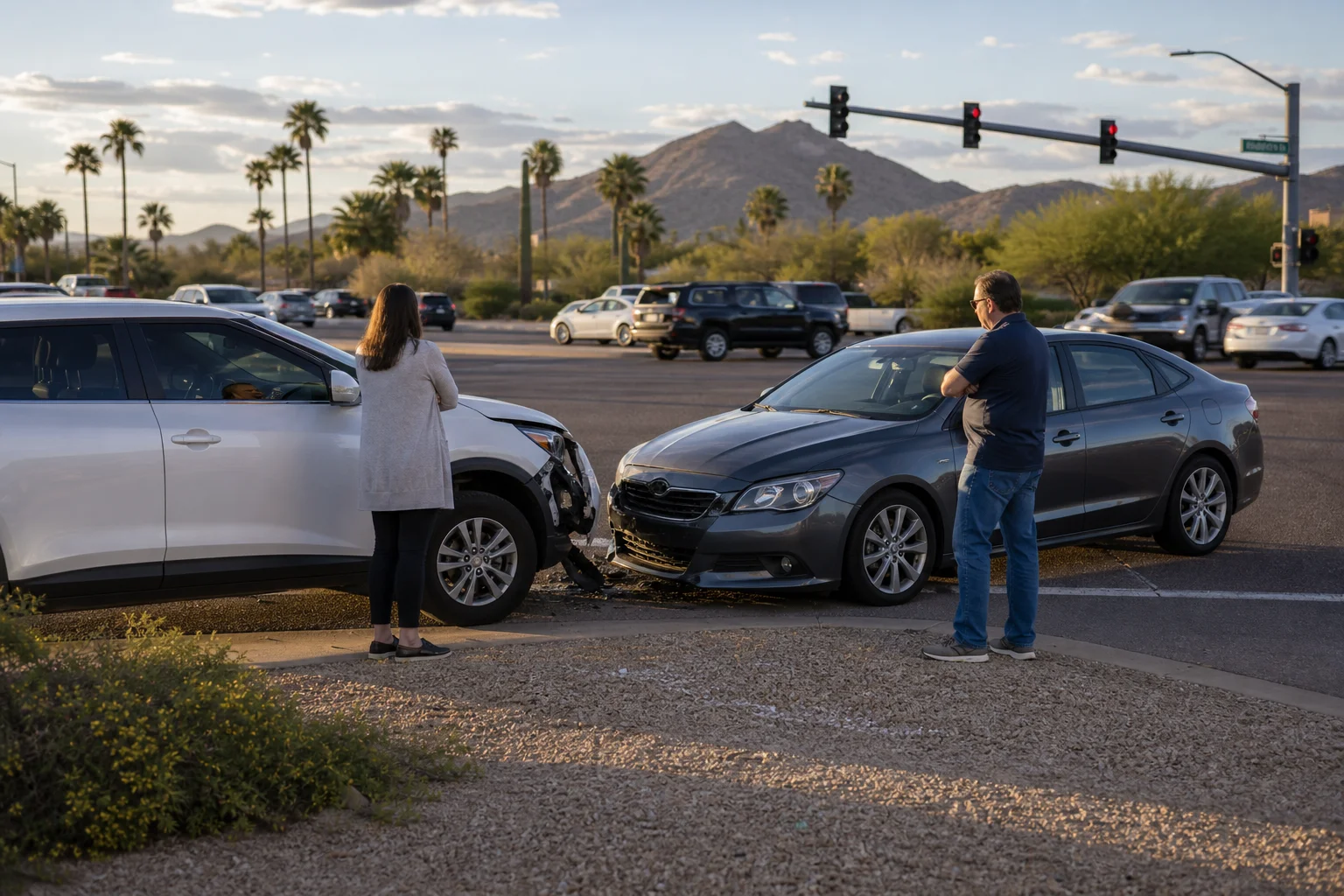
Knowing what to do after a car accident in Scottsdale protects your health, your legal rights, and your path to fair compensation. Stay at the scene, call 911, get medical attention, and don’t speak to insurance adjusters before understanding your options. Our Car Accidents guide covers each step in detail.
By Charles Paglialunga, Esq., Founder, Valley Accident Law, 29 years Arizona personal injury
Arizona law requires every driver involved in a car accident to remain at the scene. Leaving before police arrive and information is exchanged, unless you are transported by emergency medical services, can result in misdemeanor or felony charges depending on the severity of injuries involved.
As soon as you are safely out of traffic, take these immediate steps:
- Turn on your hazard lights and move your vehicle to the shoulder or a nearby parking area if doing so does not disturb the scene
- Check yourself and all passengers for injuries
- Do not admit fault, apologize, or offer explanations about what caused the crash
- Call 911 immediately and request both police and medical assistance
Many crash victims feel fine in the immediate aftermath. Don’t let that feeling stop you from following each step. Adrenaline suppresses pain, and serious injuries including whiplash, traumatic brain injuries, and internal bleeding often produce no symptoms for hours or even days after a collision.
Call 911 and File a Police Report
Under Arizona Revised Statutes section 28-667, drivers are legally required to report any accident involving injury, death, or property damage exceeding $2,000. Even when the law does not strictly require a report, filing one is strongly advisable. A police report creates an official record of the crash before memories fade and before either driver has an opportunity to change their account.
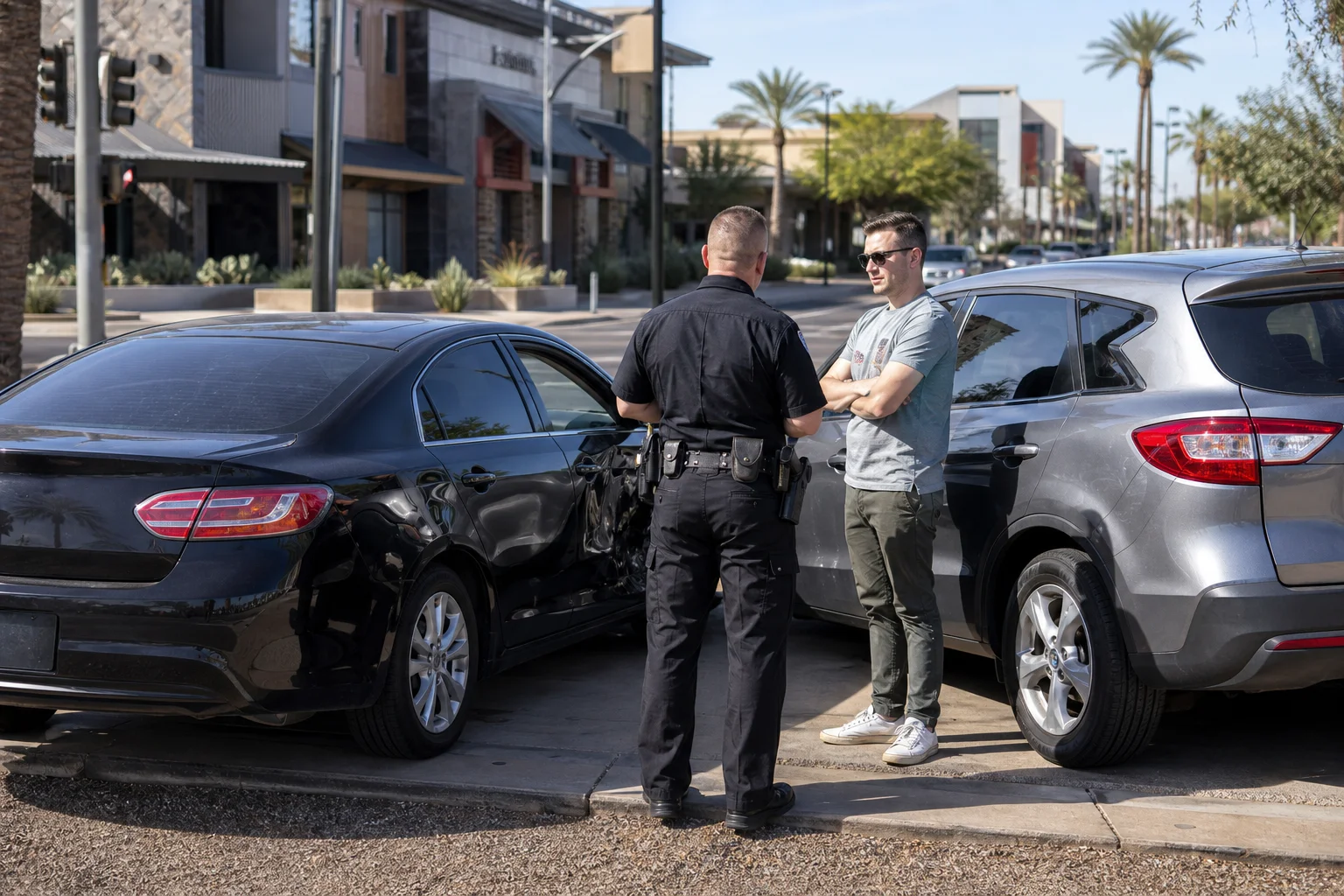
When the responding officer takes your statement, describe only what you directly witnessed. Do not speculate about the other driver’s speed, intent, or actions before impact. Fault in an Arizona car accident case is determined through investigation, not roadside impressions, and anything you say at the scene can become part of that record.
Exchange Information with the Other Driver
Arizona law requires all drivers involved in a vehicle accident to exchange information at the scene. This means providing and collecting:
- Full legal name and contact information
- Driver’s license number
- Vehicle registration details
- Insurance company name and policy number
Get this from every driver involved, not only the one you believe caused the crash. If the other driver refuses to cooperate or attempts to leave, don’t confront them. Note the vehicle’s license plate, make, model, and color, and report it to the responding officer immediately.
Also collect contact information from any witnesses who saw the accident. Independent accounts carry significant weight with insurance companies and, if your case proceeds to a lawsuit, with juries as well.
Document the Scene Before Anyone Leaves
Your smartphone is one of your most important tools after a crash. Before any vehicle is moved, photograph and video the following:
- All vehicle damage from multiple angles
- The final resting position of each vehicle in the roadway
- Skid marks, broken glass, and road debris
- Traffic signals, stop signs, and nearby lane markings
- Your own visible injuries
- The other driver’s license, registration, and insurance card
Send yourself a voice memo or text message noting the time, weather, lighting, and road conditions. This creates a timestamped record that is difficult to dispute later. If nearby businesses or traffic cameras may have captured the crash, note the locations and notify your attorney promptly. Surveillance footage is often overwritten within 24 to 72 hours, and a preservation letter sent quickly can secure critical evidence before it is gone.
Seek Medical Attention, Even When You Feel Fine
Get evaluated by a physician on the same day as the crash, or as early the following morning as possible. Medical attention within 24 to 72 hours creates a documented connection between the accident and your injuries. That connection is critical when you file a claim.
Insurance adjusters look specifically for treatment gaps as grounds to reduce or deny compensation. A delay of even a few days becomes an argument that your injuries are not serious or were not caused by the car accident in question.
Research from the Quebec Task Force on Whiplash-Associated Disorders, published in Spine (Spitzer et al., 1995), documented that symptoms from motor vehicle collisions frequently develop or worsen in the 24 to 48 hours following impact. Arizona car accident attorneys consistently advise clients to seek immediate evaluation regardless of how they feel at the scene, and to document every symptom, however minor.
Keep all medical records, prescriptions, bills, and treatment notes. These documents form the foundation of your damages calculation in any personal injury case.
What to Say and Not Say to the Insurance Company
Expect contact from an insurance company within 24 to 48 hours of the crash, sometimes from the other driver’s insurer and sometimes from your own. Insurance adjusters are skilled interviewers trained to gather information that limits your claim value. Before taking any recorded call, keep these points in mind:
- You are not required to give a recorded statement to the other driver’s insurance company
- Describing your injuries as “minor” or saying you “feel okay” can be used to reduce your compensation later
- Settlement offers made in the days immediately after a crash almost never reflect the full value of a claim, especially before the full extent of injuries is understood
- Signing a release closes your case permanently, even if you later discover new or worsening injuries
Insurance companies move quickly because speed works in their favor. Getting legal guidance before you respond to adjusters protects you from making commitments you cannot undo. A Personal Injury consultation with a qualified attorney costs nothing upfront and can significantly affect the outcome of your case.
Frequently Asked Questions
Do I have to report a car accident in Scottsdale to the police?
Arizona law requires you to report any accident involving injury, death, or property damage over $2,000. Even when not legally required, a police report protects you by creating an official account of events. Without one, a disputed claim often comes down to your word against the other driver’s, with no independent record to support either side.
What if I feel fine right after the accident?
Feeling fine immediately after a crash is common and does not mean you are uninjured. Adrenaline and shock suppress your awareness of pain. Many serious injuries, including concussion, whiplash, and herniated discs, produce delayed symptoms. Seek medical attention within 24 hours and document every symptom, even mild ones, from the day of the crash forward.
How long do I have to file a personal injury lawsuit in Arizona?
Under Arizona Revised Statutes section 12-542, you have two years from the date of the accident to file a personal injury lawsuit. Missing this deadline almost always bars your right to compensation permanently. Contact a car accident lawyer well before the deadline so your case can be properly investigated and prepared.
Can I recover compensation if I was partly at fault?
Yes. Arizona follows a pure comparative fault rule. Your damages are reduced by your percentage of fault, but you are not barred from recovery. If you were 20% at fault, you can still recover 80% of your total damages. An attorney can evaluate your specific accident arizona circumstances and advise how comparative fault applies to your car accident arizona claim.
What if the other driver had no insurance?
If the other driver carried no insurance or insufficient coverage, your own uninsured or underinsured motorist coverage may provide a path to compensation. Arizona does not require drivers to carry this coverage, but if you elected it, it can be a critical resource. Additional legal options may also be available depending on the specific facts of your crash.
Talk to a Scottsdale Car Accident Attorney Before You Sign Anything
Knowing what to do after a car accident in Scottsdale is only the first step. Making sure you don’t sign away your legal rights before understanding what your claim is actually worth is equally important. Contact / Free Case Review to speak directly with Charles Paglialunga, Esq., at no cost and with no obligation.